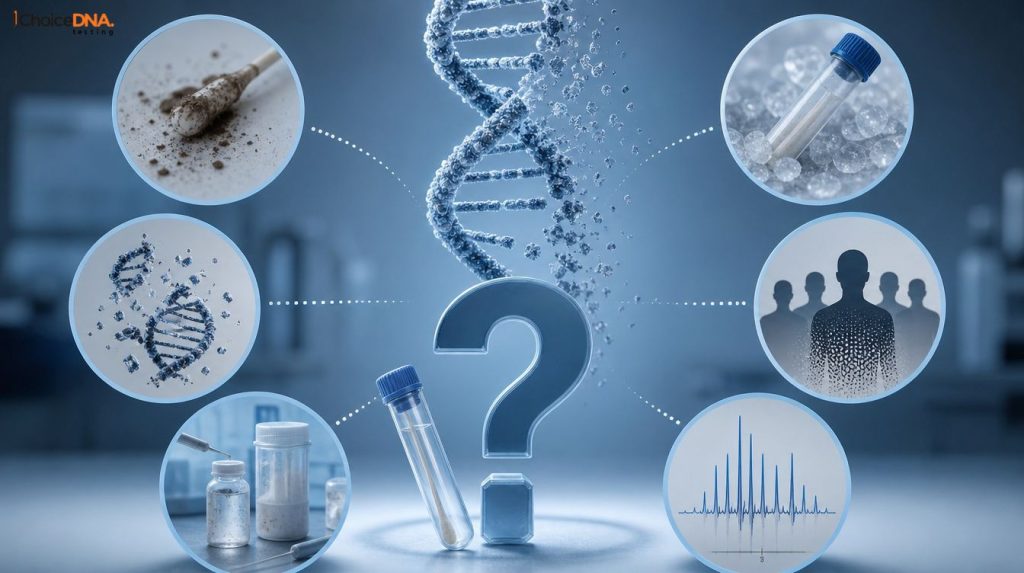

An unclear DNA test result can feel frustrating. You may wonder why it did not give a clear answer. You might also worry that the relationship you are trying to check cannot be confirmed. This can be confusing and even a bit concerning, but for nearly all cases, there is a clear and correctable explanation. Learning the reason behind this can help you to feel better prepared to take the next step. In this blog, we will simplify some of the most common reasons for the DNA test to be inconclusive for everyone’s understanding.
What it means to have an inconclusive DNA test and why does it happen?
An inconclusive DNA test result is when a DNA lab was unable to make a clear conclusion of a biological relationship. It is not a complete failure of the test nor that there is something wrong with the people involved. It typically reflects a technical problem (e.g., sample quality, contamination, or limitation in the test) and is not indicative of a problem with the actual biological relationship being studied. This can be overcome relatively easily by taking a fresh sample that is handled correctly and testing it again at an accredited laboratory.
Is there any inconclusive test result due to a poor or inadequate DNA sample?
Yes, it is one of the most frequent reasons for an inconclusive DNA test: poor or insufficient sample. The lab may have an insufficient amount of usable DNA for comparison if the swab does not capture adequate numbers of cells or if the sample is damaged prior to testing. It’s usually a simple problem to correct with a brand new and correctly taken sample. If you follow the collection instructions carefully, for example, avoid touching other surfaces and swab long enough, this risk is significantly reduced.
The quality and tests of DNA.
- When the amount of DNA is not sufficient for the swabbing procedure.
- If the sample gets dry or has been improperly stored, it will need to be replaced.
- Heat or moisture damaged sample
- Poor or compromised DNA decreases test accuracy.
What problems can be caused by contamination or poor sample collection?
Contamination occurs when the outside DNA comes in with the sample, obscuring the results or making them unreliable. This can happen if a swab comes into contact with food, other people’s DNA, or unclean surface prior to or during collection. Proper and directed sampling minimizes the risks of contamination to an inconclusive paternity test result. This is why it is crucial to have clear instructions for collecting waste and to handle it properly throughout the process to ensure a dependable and trustworthy outcome.
Common Sample Collection Issues
- Pre-contact of swab tip before use
- Eating or drinking just before swabbing
- Combining samples from more than one individual
- Non-sterile collection materials – use of non-sterile collection materials are acceptable.
Can testing too few DNA markers make a paternity test inconclusive?
Yes, the less DNA markers tested, the more likely there will be a case of an inconclusive DNA test, as there will be less information to compare. Usually, the more markers that are used in reliable paternity testing the more likely it can come to a conclusion that is confident and statistically sound, particularly when the family testing is not a direct match; the more the more complicated the situation. A comprehensive marker panel can also minimize the risk of borderline or ambiguous results.
The accuracy of DNA markers.
The more the DNA markers that are tested, the more detailed the comparison of samples will be. In complex cases, fewer markers sometimes may result in less clear or ambiguous results. When using a large marker panel, it offers the added benefit of being able to be accurate, reliable, and confident of the results’ meaning.
What if it doesn’t resolve a conclusion?
Getting an inconclusive result does not mean the process is over. Most labs provide instructions for sample collection or retesting with other markers to reach a conclusion. Such as if cheeeck swab doesn’t come to a conclusion, a blood or hair sample can be more reliable. If you understand how to read your paternity DNA test results, you will also know exactly what your DNA test report is telling you, such as any comments or suggestions given by the DNA testing laboratory about the sample quality or what you should do next.
The need to work with an Accredited Lab.
The chances are reduced significantly if a lab that adheres to approved procedures is selected. The clarity and reliability of answers depend on careful sampling, appropriate storage and intensive marker testing. Each report is read thoroughly by a licensed expert, who can assist a family in understanding your DNA testing results and what the next step may be.
When it comes to a sensitive matter, such as a divorce, every family needs to be equipped with clear, reliable answers. At Choice DNA, we provide accredited paternity DNA testing to reduce any inaccuracies and to provide easy-to-understand results.

Conclusion
An inconclusive DNA test result is typically due to sample or test problems, and not the relationship, and can often be repeated for a better result. With accredited, accurate testing designed to minimize these problems, Choice DNA can provide families with the clear, reliable answers they deserve. As a non-invasive prenatal paternity test, our blood test can give a safe, reliable answer before the baby is born and is performed in CAP-accredited laboratories where special care is taken to ensure the accuracy of the results and to maintain the quality of the samples.