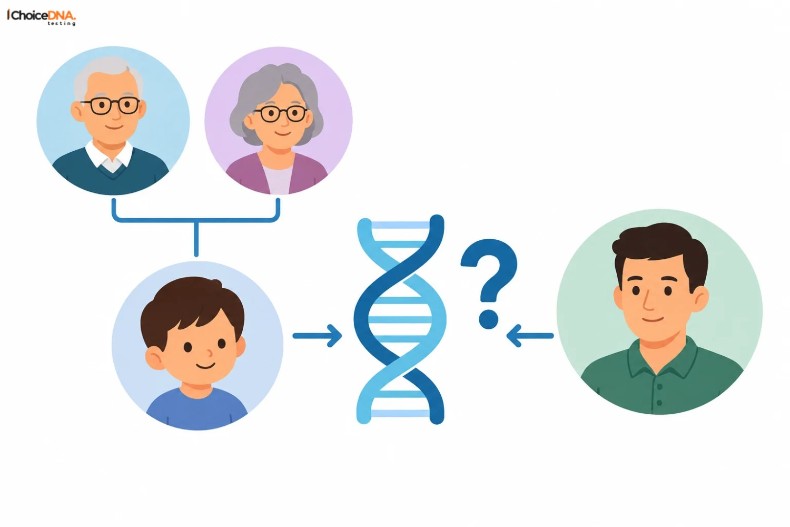

No, a mother’s parents, on their own, will not prove paternity. However, they can still support the child, especially if the child’s mother can’t participate. When parents have died, are unavailable, or refuse to be involved in the process, this is a question that’s frequently asked when family members are not certain about who might be able to help. When key people are missing, DNA questions can get tricky, and that’s where other relatives can help. This blog works with DNA testing every day and wants to share this information clearly and honestly. Here are some topics it will cover: what maternal grandparents can prove, what they can’t, how to take the sample, and which other tests might help.
What is a grandparent DNA test, and how can it help establish a child’s biological relationship to a family?
A grandparentage DNA test is a comparison of a child’s DNA to DNA from one or both grandparents. It is typically used when a parent cannot be tested. The lab searches for the DNA the child should have inherited from that family. The results indicate the probability that the relationship is biological.
The Genetic Connection Between Grandparents and Grandchildren
All children inherit half of their DNA from each parent. 50% of each parent’s DNA comes from their own parents. That translates to an average of 25% shared DNA between a child and each grandparent. It’s all about which side you’re testing. The father’s grandparents are paternal, and the mother’s are maternal. Their DNA can only testify on behalf of their child’s side. This is the main concept in the Exploring the Difference Between Paternal and Maternal Relatives in Genetic Relationship Testing lesson. The right side of the family, the right answer from the lab.
Can maternal grandparents be used for a paternity test if the alleged father is unavailable?
Not by themselves. Maternal grandparents can only confirm what the child has received from the maternal side of the family, not the father. Without the alleged father, testing typically requires someone with the father’s DNA. Maternal grandparents can help as part of a broader test.
Indirect DNA testing becomes a viable choice.
- Father passed away: His parents may test in his place.
- Father refuses or is missing: His relatives may agree to help.
- Mother is not available: Her parents can represent her.
- If both parents are missing, the grandparents (on both sides) can test together.
- Families may require proof after a death (as a result of inheritance or benefits).
- The sense of security: For some families, they need to know before they plan.
- Order first: If you have an expert, they can confirm your relatives before you order.
- Biological family history: This medical history can be completed with the biological family.
What does a maternal grandparent DNA test do to determine whether a man is the child’s biological father?
The laboratory determines which parts of the DNA the child probably inherited from his mother if she is unavailable for testing. The lab tests the child’s DNA against the mother’s parents’ DNA and separates any DNA segments that might have come from them. The remaining pieces come from the biological father. These are referred to as obligate paternal alleles. The lab then determines if the alleged father (or his relatives) also have those DNA markers. He can be excluded if they do not. If they do, the DNA markers increase support for paternity.
How is DNA collected for the maternal grandparent DNA test and how long does it take?
- Everyone gets a soft cotton swab rubbed in his or her mouth.
- Samples may be taken at home with an at-home DNA kit or at an approved collection site and sent to the lab by mail.
- A grandparent test result is typically available within 3 to 5 business days of the time the lab receives the test.
How to expect the sample to be submitted to the final report.
- You will complete a short form prior to collection that will include details on each person and their relationship to the other. Labeling is important; each envelope should have the correct name.
- Don’t eat, drink, or smoke for 30 minutes before swabbing, and allow swabs to dry before sealing.
- Once the kit arrives at the lab, extract the DNA and read numerous markers for each person.
- If a swab fails, the lab may request another, and the timeline may be extended by a few days.
Each person’s markers are shown side by side on the final report. It also provides a grandparentage index and a DNA relationship probability, in percentage. The higher the percentage, the stronger the support for the interrelationship being tested. These results are typically shared safely online or by email, and a specialist can explain what the numbers mean.
Does the testing of both maternal and paternal grandparents offer more evidence than the testing of just one?
Yes. Typically, testing both maternal grandparents lets the lab determine the mom’s side more accurately than testing only one. Is a grandparent DNA test reliable with just one grandparent? It can still help, but it’s less predictable and requires more family members to participate.
The analysis depends on how many family members are available.
Both grandparents are tested, and the lab can view all of the mother’s DNA pieces. One half of her possible DNA remains unanswered, and more patterns fit. That makes it harder to distinguish the mother’s DNA from the father’s. The more willing the right relatives are to participate in grandparent DNA testing, the more accurate the results will be, including the alleged father’s parents. The best results come from adding the mother, if she is available later. Anyone who asks, “How Accurate is Grandparent DNA Testing?“ should also know it depends more on who you can obtain than on the testing method.
If maternal grandparent testing isn’t an option, what other options can families consider?
In the event that the mother’s grandparent tests are inconclusive, families may take the additional step of testing relatives from the alleged father’s side. These could include his parents, brothers, sisters, or other children. Special tests that pass only through the father’s line and or only through the mother’s line may also help, depending on who is available and willing.
Sibling and Other Relative-Based Testing Options
- Alleged father test: Compares the child to another alleged father.
- Avuncular test: Relies on an alleged father’s full brother/sister.
- Paternal grandparent test: Usually provides the best circumstantial evidence of paternity.
- Y-DNA test: For males, compare the Y chromosome with a male relative on the father’s side.
- mtDNA test: Passed down through the mother’s line; confirms maternal relatives, not fathers.
- X-DNA test: May indicate whether two sisters have a shared father.
- Samples from the alleged father stored: A medical sample from the alleged father can be tested with permission.
- Extended family: Paternity first cousins in some cases.
Are maternal grandparent DNA test results admissible in court?
Yes, but only if the test is conducted in accordance with the legal rules from start to finish. A home test is not admissible in court. A legal grandparent test requires a neutral collector, paperwork, and an accredited laboratory. The extent of the weight attached to the results will be determined by each court.
- The chain of custody, identity verification, and court requirements.
- Must bring photo ID: All adults present with government-issued photo ID (current and valid).
- Photos and signatures: Every person will have their photo taken and sign a consent form.
- Child’s identity: May need the child’s birth certificate.
- Sealed samples: Swabs are on-site tamper-evident sealed.
- Paper trail: A chain-of-custody form tracks who obtained the sample, who handled it, and when.
- Court rules change; ask whether your court requires a certain lab or form.
- Paperwork: Legal tests take longer because of the paperwork.
At Choice DNA, we help families arrange legal grandparent tests, and we send samples to our AABB-accredited laboratory partners.

Conclusion
The maternal grandparents can’t answer the question, but they can be an important part of a carefully designed family test. The key is to select relatives with DNA who can answer your question. Don’t order a test without help, or your test will tell you what you don’t need to know. Family seeking clarity: Choice DNA provides DNA testing, ancestry DNA testing, mtDNA testing, and Y DNA testing.