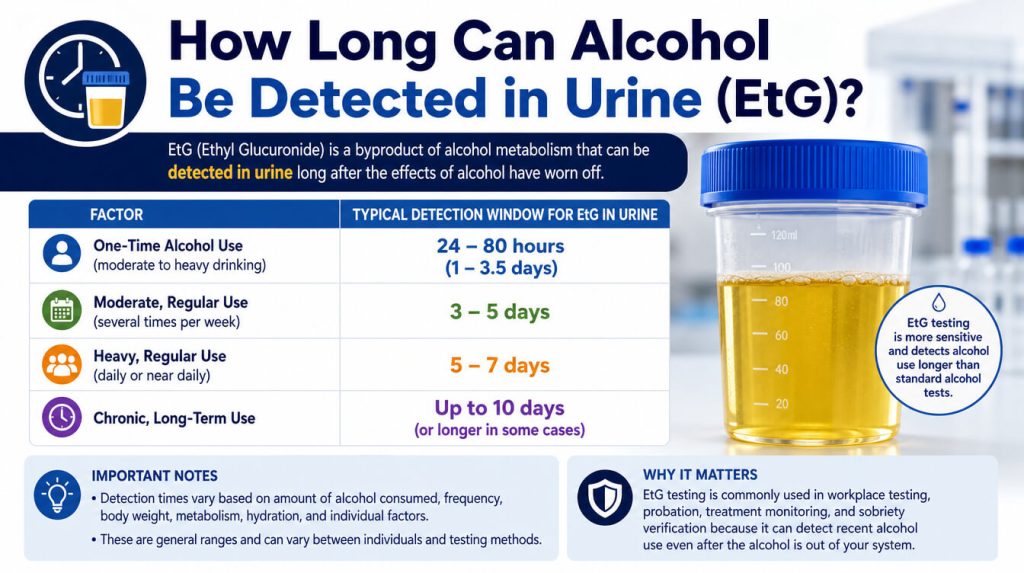
The short answer is that an EtG urine test can pick up alcohol use for roughly 1 to 3 days after a light-to-moderate night, and sometimes up to 80 hours or more after heavy drinking. That’s a lot longer than the 12 hours or so you’d get from a standard urine alcohol test.
The honest answer has more to it than one number, though. The window depends on how much you drank, the cutoff the lab uses, your body, and even the type of test. Below we break it all down in plain language.
Quick Answer: EtG Detection Times at a Glance
| Type of test | Typical detection window |
|---|---|
| Alcohol (ethanol) itself in urine | About 12 to 24 hours (some sources say up to 48) |
| EtG, light drinking (1–2 drinks) | Roughly 12 to 36 hours |
| EtG, moderate drinking | Around 2 to 3 days |
| EtG, heavy or binge drinking | 3 to 5 days |
These are realistic planning ranges, not guarantees. Labs and studies report different numbers because cutoffs and test sensitivity differ. Mayo Clinic Laboratories, for example, states that EtG and EtS can be detected up to 5 days in urine using a 500 ng/mL cutoff, while studies of non-dependent drinkers report EtG in urine for as long as 80 hours (about 3.3 days) after heavy drinking.
What Is an EtG Urine Alcohol Test?
When your body breaks down alcohol, a small fraction is converted into a byproduct called ethyl glucuronide (EtG). A second byproduct, ethyl sulfate (EtS), forms the same way, and many labs test for both.
This is why the test works so well. Alcohol itself clears your system fast. EtG hangs around in urine long after the alcohol is gone, so the test tells a lab whether you drank recently, even if you’re completely sober at the time of the sample.
People are usually asked to take one for a few reasons:
- Court-ordered or probation monitoring
- Custody and family court cases
- Treatment and recovery programs
- Workplace and professional monitoring (healthcare, aviation, and similar fields)
- Transplant or liver-related medical programs
Can You Test for Alcohol in Urine?
Yes, and there are really two different tests that people mix up:
- A standard urine alcohol test looks for ethanol itself. It only catches very recent drinking, usually within about half a day.
- An EtG (or EtG/EtS) test looks for the metabolites. It reaches much further back, which is why it’s the go-to when someone needs to show they’ve been abstinent.
If a form just says “alcohol urine test,” ask which one it is. The detection window changes completely.
How Long Is Alcohol Detectable in Urine?
Here’s how to think about it by amount and cutoff.
One or two drinks. At a sensitive 100 ng/mL cutoff, you may still test positive a day or so later. At a 500 ng/mL cutoff, it often clears sooner. Clinical sources note that light drinking typically produces detectable EtG for up to about a day at lower cutoffs, while heavy intoxication may stretch the window to around three days.
A solid night out. If you had several drinks, plan on 2 to 3 days.
Binge drinking or several days of heavy use. EtG can build up and stay detectable 3 to 5 days, sometimes longer in people with kidney problems.
Realistic EtG Detection Times (What the Cutoff Changes)
The cutoff is the concentration a lab uses to call a result “positive.” A lower cutoff catches more, for longer.
Research comparing cutoffs found that moving from 100 ng/mL up to 200 ng/mL reduced sensitivity but improved specificity. In plain terms, a lower cutoff finds more drinking but also flags more incidental exposure.
SAMHSA’s 2012 advisory is where most interpretation guidance comes from. It describes three tiers: very low positive (100–500 ng/mL), low positive (500–1000 ng/mL), and high positive (above 1000 ng/mL).
| EtG level | What it may suggest |
|---|---|
| Under 100 ng/mL | Usually negative |
| 100–500 ng/mL | Possible recent light drinking, or incidental exposure |
| 500–1,000 ng/mL | Possible drinking in the previous day or so, or heavier exposure |
| Over 1,000 ng/mL | Likely drinking within the past day or two |
One more important point: SAMHSA doesn’t treat a positive EtG as proof on its own. Guidance based on that advisory says a positive EtG shouldn’t be used as stand-alone evidence of drinking, and even a 500 ng/mL cutoff still calls for corroborating information.
What Affects How Long Alcohol Shows Up in Urine?
Two people can drink the exact same amount and get very different results. These are the main reasons:
- How much you drank. More alcohol means more EtG and a longer tail.
- How fast you drank it. A fast binge looks different from the same amount spread over an evening.
- Kidney function. Slower kidneys clear EtG more slowly, which lengthens the window.
- Body size and metabolism. Body weight, age, sex and liver health all play a part.
- Hydration and dilution. Very dilute urine can push levels below a cutoff, but labs often check creatinine to flag dilution, so this isn’t a reliable trick.
- Sample timing. First-morning urine tends to be more concentrated than a mid-day sample.
- The cutoff and the test. Lab LC-MS/MS testing is generally more precise than a home dip test.
How Long Does Liquor Stay in Your Urine?
People often ask this as if whiskey, vodka or tequila behaves differently from beer. It doesn’t. Your body processes ethanol the same way regardless of what it came in.
What matters is the amount of pure alcohol. A 1.5 oz shot of 80-proof liquor, a 12 oz beer and a 5 oz glass of wine each contain roughly the same alcohol. So a few shots of liquor leave the same footprint as a few beers. The only real difference is that spirits make it easier to take in a lot of alcohol quickly, which raises how much EtG you produce.
Will Non-Alcoholic Beer Show Up on EtG?
It can, though it usually takes a lot. “Non-alcoholic” doesn’t mean zero. In the US, products labeled that way can contain up to 0.5% alcohol by volume.
A well-known study had volunteers drink 2.5 liters of non-alcoholic beer. EtG and EtS in urine rose above the commonly used 0.1 mg/L abstinence cutoff in several volunteers, while ethanol itself came back negative. One participant’s levels built up overnight to much higher concentrations.
Another study found that large amounts of non-alcoholic beer produced positive EtG findings up to 13 hours later, with sauerkraut up to 5 hours and ripe bananas up to about 3.5 hours.
So a single can is unlikely to cause trouble, but if you’re being monitored, the safest move is to skip non-alcoholic beer entirely. If you drink it anyway, tell your testing program in advance rather than explaining it after a positive.
Other Things That Can Cause an EtG Result
Alcohol you didn’t drink can sometimes register:
- Alcohol-based hand sanitizer used heavily and repeatedly (labs have published studies on sustained sanitizer exposure)
- Mouthwash containing alcohol
- Some cold medicines, tinctures and flavor extracts
- Fermented foods and ripe fruit, in large quantities
- Sugar in urine from certain medical conditions, where fermentation can occur in the bladder or in the sample container
If you’re in a monitoring program, read labels, switch to alcohol-free products, and keep a note of anything unusual. This protects you if a borderline result comes up.
EtG on a Drug Test: Is It Included?
Usually not. A standard 5-panel drug test or 10-panel drug test screens for substances like marijuana, cocaine, opiates, amphetamines and PCP. Alcohol isn’t part of those panels, so a clean result tells you nothing about whether someone has been drinking.
EtG is normally ordered as a separate test, or added as an extra item on a broader panel. Which one you get depends on the program. Some monitoring programs ask only for EtG, others pair it with a drug screen, and some check alcohol by breath or saliva instead.
That’s why the wording on your order matters. A request for a “drug and alcohol test” could mean EtG, a standard urine alcohol test, or a breathalyzer, and each looks back over a very different time frame. Before you go, check exactly which tests are on your order. If EtG is included, you’ll know the test can reach back a few days, not just a few hours.
If you want a broader look at how different substances are screened, see this overview of drug testing.
Can You Speed Up the Process?
No safe shortcut works reliably. Drinking lots of water, exercising, or using “detox” products won’t dependably clear EtG, and a sample that’s too dilute can be flagged or rejected. The only thing that works is time.
If you’re facing a scheduled test, the most practical approach is to stop drinking well ahead of it. For most people, a clean 5 days gives a comfortable margin, even after heavy drinking.
Why Choose a Certified Lab for Alcohol Testing?
Results matter a great deal when your job, custody case or recovery is on the line. A reliable lab should offer:
- Proper collection and chain of custody when results may be used in court
- Confirmation testing by mass spectrometry, not just an initial screen
- Clear reporting of EtG and EtS levels against the cutoff used
- Support when you have questions about a result
EtG testing is offered by laboratories that handle alcohol and drug screening, including Choice DNA. Whichever lab you use, make sure you know which cutoff level they apply and whether the result is a screen or a confirmed lab analysis.
Final Thoughts
EtG testing is sensitive, and that’s the point: it shows alcohol use long after the buzz is gone. For a light drink, expect about a day or two. After heavy drinking, expect several days, and up to 5 in some cases.
FAQs
How long does alcohol stay in your urine?
Ethanol itself usually clears within about 12 to 24 hours. EtG lasts longer, often 1 to 3 days and up to about 5 days after heavy drinking.
How long do EtG tests detect alcohol?
Most EtG tests detect drinking from the past 1 to 3 days, with an upper range around 80 hours or more after heavy use.
Will one beer show up on an EtG test?
It can, if you’re tested within about a day and the cutoff is low. At a 500 ng/mL cutoff, one drink is less likely to still register after 24 hours.
Can an EtG test be wrong?
It can be positive from incidental sources, and negative if urine is very dilute. That’s why a positive is usually interpreted with other information.
What’s the difference between EtG and EtS?
Both are alcohol byproducts. Testing for both improves reliability, since EtS is less affected by some bacterial issues.
Can a urinary tract infection affect results?
Yes. Certain bacteria can break down EtG in a sample and cause a false negative.