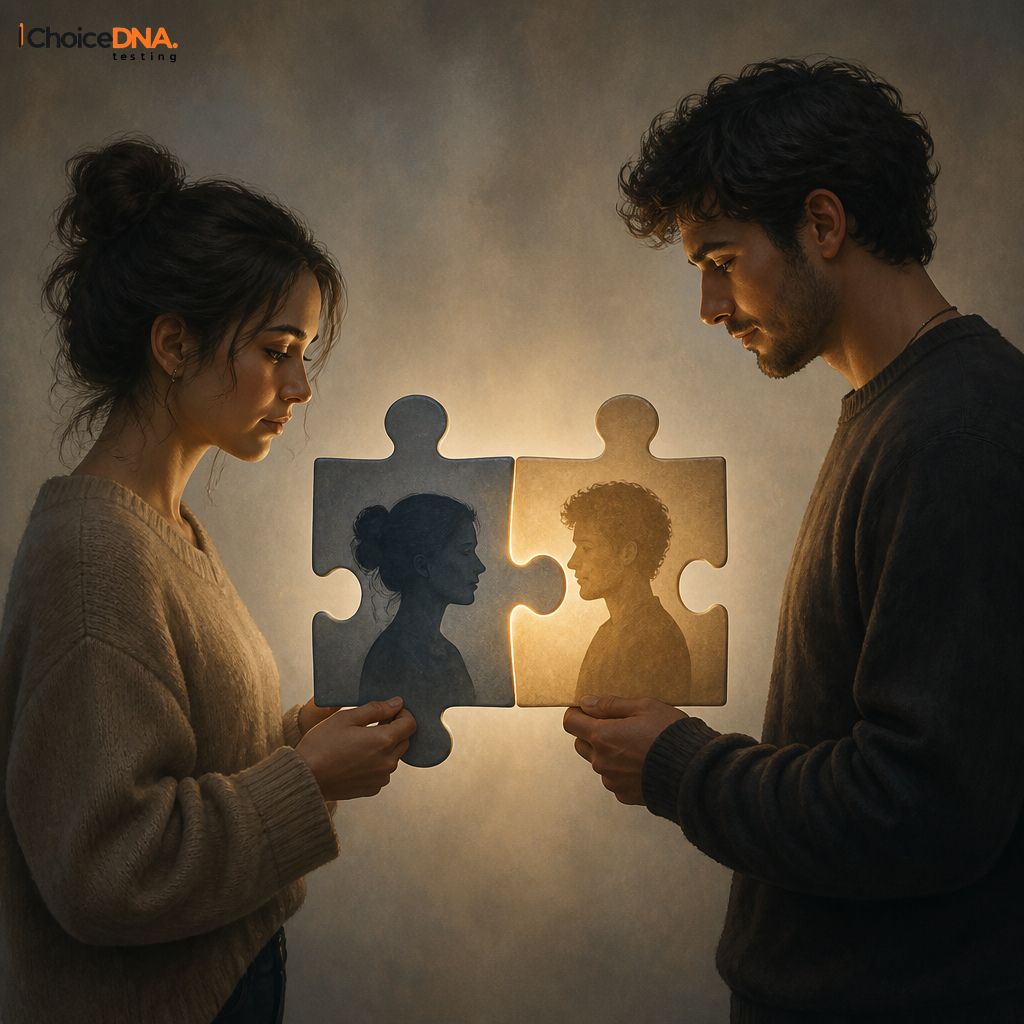

The best way to determine whether you are connected to a person is to perform a DNA test and today, DNA testing is more easily, accurately and simply conducted than most people think. DNA Testing can help you answer questions such as Who am I related to after an adoption, if you suspect a family connection, or just curious as to how you are related to this person you always wondered about? DNA Testing can provide you with a science-backed answer, and no family story or resemblance can come close to a certainty.
How to know if you are genetically related to someone?
The easiest way to determine if two individuals are related is by having their DNA compared by a professional laboratory test. Biological parents pass on genetic material that creates measurable, detectable patterns among generations. Such patterns can be used to compare two people and see if and how much they are biologically related, even if family records are absent or one person may not have a thorough biological record.
DNA testing and genetic relationships.
DNA Testing establishes biological connections by comparing the genetic profile of two or more people. Portions of shared DNA (centimorgans) reveal the nature and degree of the biological relationship. The greater the DNA they share, the closer the relationship. Accurate, documented results are offered for any relationship question through professional lab testing using CLIA approved facilities.
Is a DNA Test Accurate enough to Determine Family Relationships?
Yes, a DNA test can determine if two individuals are related and can, in many instances, show the type of relationship if the shared DNA is not ample. The test is based on a comparison of certain genetic markers from both persons’ DNA profiles and determines the likelihood of a possible biological relationship. The results are very clear for close relationships, such as parent-child, siblings, grandparent-grandchild. Results give high probability indicators for more remote connections and should be used in conjunction with the family history information that may be available.
How can Shared DNA help to show family connections?
Close biological relationships, such as parent-child or full sibling, share large amounts of easily measurable DNA, which yield high-confidence results when two people are tested and their profiles are compared professionally.
Relationships further removed are also detectable via the DNA, although they have less DNA shared, and can be assigned to a range of relationship probabilities by a laboratory professional. Half-siblings, cousins, avuncular, etc. relationships have smaller amounts of shared DNA, but the DNA can still be detected and placed within ranges of relationship probability by a professional laboratory.
Don’t assume your “family” is related, only to find out who you’re related to through professional testing , physical resemblance and family histories are not scientifically valid proof of familial relationship.
Which DNA test is most effective in determining biological relatives?
The ideal DNA test will vary based on the type of relationship being studied. There are various types of tests that are used for various situations in relationships — and the right test, applied first, will give you the most accurate and useful answer for your specific question.
Comparing Relationship, Paternity, and Ancestry DNA Tests
When establishing a biological relationship between a father and a child, the most accurate option is paternity DNA testing which provides a profile of the child and the alleged father and identifies a relationship with a 99.9% or higher probability of inclusion or conclusive exclusion.
Relationship DNA testing such as sibling testing, grandparent testing and avuncular testing are created to help establish a biological relationship when the direct parent is not present.
When only a specific relative is not identified by Ancestry DNA testing, a wide database match is used to find a possible biological relative based on common genetic segments; it proves useful when searching for unknown relatives when the relative in question has also tested their DNA with the same database service.
How Much DNA Do Relatives Typically Share?
With each generation between the two generations and individuals the percentage that is shared diminishes, and it is important to be able to interpret the test results from these ranges to get a clear understanding about how am i related to this person to this number of centimorgans.
Understanding Shared DNA and Different Family Relationships
Parents and children have about 50% of their DNA in common, which is the greatest possible sharing amongst non-identical twins. About 50% are shared on average by full siblings. Half-siblings share approximately 25%. The average grandparent- grandchild relationship is approximately 25%. First cousins have approximately 12.5% of their genes in common. Between two biological relatives, these percentages go down in a predictable manner with every additional step in generations.
Choice DNA collaborates with CLIA-certified laboratories to offer professional relationship DNA testing services such as paternity, sibling, grandparent and avuncular testing using full chain-of-custody and scientific documentation. You may need personal clarity into who you are, or legal confirmation about a biological connection; whatever the case may be, Choice DNA provides results that you can trust 100%.

Conclusion
To determine whether or not an individual is related to another is now an easy, scientific task. Whether it’s a parent, sibling or a stranger, there’s nothing like a clear, official DNA test to answer the question. Offering full relationship DNA testing services, Choice DNA helps every family find clarity and certainty with its CLIA-accredited laboratory partnerships. Seek professional assistance; the answer to this question is too complex to guess.