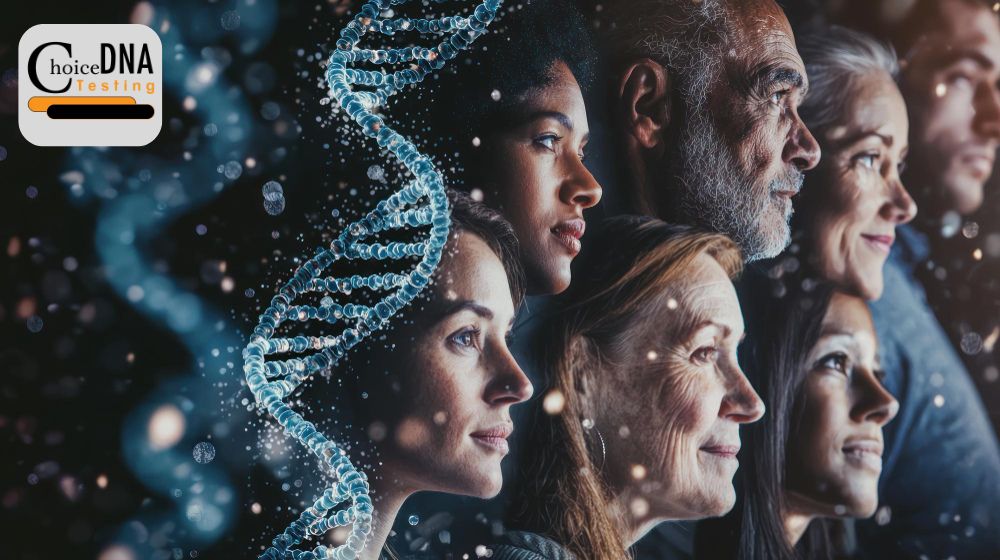

Have you ever thought of asking yourself whether you are related to the whole world? The solution to this may shock you. DNA science is of the view that we are all one great family tree. You have your neighbor, your most popular movie star, and halfway around the world, who have the same ancient relatives as you do. Researchers have found out that all human beings on earth today belong to the same group of early human beings who lived many years ago. We should learn what your genetic code tells you about your relationship with all the people on the planet and reveal how exciting a story is written in your genetic code.
Are human beings all genetically connected by DNA science?
Yes, there is a common ancestor of all who live today. Imagine it in the following way: suppose that you went back in your family tree many thousands and thousands of years, you would come at length to individuals who are also the great-great-great-grandparents of everyone. This isn’t just a theory. The DNA structure of the cells in our bodies has been investigated by scientists, and there is evidence of evolution linking all of humanity. When did humans first appear? Contemporary human beings appeared about 300,000 years ago in Africa. Nowadays, our species has covered the world, but we are all genetically marked as descendants of the same ancestral population.
Shared Human Ancestry Explained.
The evolution of man is an interesting story. Our homo sapiens species evolved out of the previous human species over millions of years. All human beings today originated in the same small population of early men who lived in Africa. When these people expanded and migrated to other areas, they brought the same fundamental gene code with them.
What the DNA Tells Us about the Typical Origins.
- Our DNA is 99.9% the same: All human beings are very similar, genetically.
- Common genetic markers: The DNA sequences are specific sequences that occur in all people of the world, thus demonstrating a common ancestry.
- Molecular evidence: The evidence of evolution in our genes has obvious patterns of common descent.
- Universal genetic code, The scientists have discovered that the universal DNA structure is found in all human cells.
To what extent is the human race related to each other in the world?
Human beings possess about 99.9 percent of their DNA in common. It implies that when you compare your genetic composition with any other person, be it a neighbor or several miles away, you would discover almost the same in terms of DNA. Our DNA has only 0.1 percent of the variation that explains all the differences that we have, such as our eye color, height, and so forth. That small percentage is what results in the gorgeous diversity that we witness, and the sheer genetic sameness is a testament that we are all close kinsmen by blood.
Genetic Homogeneity Among Populations.
DNA of individuals in the various continents is compared by scientists and they always conclude that humans are one of the most genetically related species on the planet. Even people living on different sides of the ocean thousands of years ago are strikingly similar. This biological resemblance proves that we have a common history.
What Small Differences in DNA Signify?
- Individual uniqueness: The 0.1 percent constructs the individual traits and characteristics of the person.
- Population adaptations: Small genetic differences helped the groups adapt to the local environment.
- Recent divergence: The minor variations suggest the human population separated recently on the evolutionary level.
- There are no biological races: It has been demonstrated by genetic science that human variation is continuous, and not separated into specific groups.
What does the mitochondrial DNA and the Y-DNA tell us about the early human ancestor?
Special genetic tools used to determine our lineage in the past include the Mitochondrial DNA (which is inherited through the mothers) and the Y-DNA (which is inherited through the fathers). Studies indicate that all humans living today can be traced by the female line to one female, popularly known as Mitochondrial Eve, who lived in Africa around 150,000 years ago. On the same note, Y-DNA analysis indicates that there was a common ancestor, Y-Chromosomal Adam, a male who lived around 200,000 years ago. These are not the only individuals who existed at that time, but they are the ancestors whose genetic material has remained to the present day, and everyone who currently lives is the result of them.
Finding Maternal and Paternal Lineages.
The ancestry DNA testing services provided by Choice DNA these particular genetic markers to trace your family tree. Mitochondrial DNA is stable because it is not altered much with change of generation forming a clear breadcrumb trail of the mother. Y-DNA does likewise to the paternal lines and assists scholars to recreate past family relationships.
The Notion of Genetic “Common Ancestors”
A common ancestor is not an individual person but a group of people, upon which all existing humans are based. These primitive mankind were organized into small groups. With the course of time, certain genetic lines were killed as others thrived. The ancestors that we acknowledge at present are just those whose offspring survived to be everyone that is alive today.
What are the population migrations that occur to elaborate on genetic relationships between humans?
Once humans first emerged in Africa, our ancestors started to move to other continents in the course of the migration, which commenced about 70,000 years ago. Such migration patterns created genetic traces that can be read even today by scientists. The people who moved and settled in new places brought with them their DNA that mixed with that of those they came across on the way. The result of this continuous movement and mix resulted in the genetic relations that we can observe across the globe. These ancient journeys can be managed through Choice DNA’s relationship DNA testing services, which help in determining genetic markers that are unique to various geographical locations.
Migration and DNA Evidence of Man.
Human DNA evidence indicates that humans moved out of Africa in waves and across Asia, Europe, and finally the Americas and Oceania. Both of the migrations left behind characteristic genetic marks. Once you learn these patterns, you realize that in every single modern human, there is a record of these primitive journeys in our genetic structure.
Finding the World with Ancestry Testing.
- Haplogroups: Genetic markers indicating the specific migration path that your ancestors took.
- Regional ancestry: Stretches of DNA that display the geographical locations where your ancestors resided.
- Connection discovery: Tests will be able to determine any living relatives that share parts of your DNA.

Conclusion
It is interesting to learn that we are all related as humans, but what of the story of your individual self? Our services of ancestry DNA testing at Choice DNA assist you in uncovering the secrets in your exclusive genetic code. Are you interested in knowing your ethnicity, or do you want to find out the relationship between your mother and father, and you require our relationship DNA test services to verify that you are related to your parents or relatives? You have the right people in our laboratory to give you the right and accurate results.